Before you start
Most summer houses have no documentation. Find out these facts, or mark them as questions for the electrician.
Typical summer house circuits
Few circuits, but each one well protected. In a wooden house the planner puts lighting and socket circuits on combined AFDD + RCBO devices.
| Circuit | Breaker | Cable mm² | Protection | Note |
|---|---|---|---|---|
| Lighting · living room and bedroom | B10 | 3 × 1.5 | AFDD + RCBO 30 mA | Arc detection where cables run in wood. |
| Lighting · kitchen, bathroom, outdoor | B10 | 3 × 1.5 | AFDD + RCBO 30 mA | Outdoor fittings IP44 or better. |
| Living room sockets | B16 | 3 × 2.5 | AFDD + RCBO 30 mA | Heaters on extension leads are a classic fire cause. |
| Kitchen sockets | B16 | 3 × 2.5 | AFDD + RCBO 30 mA | Kettle and hot plate: watch the 25 A supply. |
| Bathroom socket | B16 | 3 × 2.5 | AFDD + RCBO 30 mA | Outside zones 0–2, splash-proof. |
| Outdoor sockets | B16 | 3 × 2.5 | AFDD + RCBO 30 mA | For the lawnmower and garden tools; IP44 or better. |
| Water heater 1.5 kW | B16 | 3 × 2.5 | Own RCBO 30 mA | Water and power together: 30 mA is mandatory. |
| Well pump | C16 | 3 × 2.5 | Own RCBO 30 mA | Curve C for motor start; cable rated for the pump route. |
Lighting · living room and bedroom
- Breaker
B10- Cable · mm²
- 3 × 1.5
- Protection
- AFDD + RCBO 30 mA
Arc detection where cables run in wood.
Lighting · kitchen, bathroom, outdoor
- Breaker
B10- Cable · mm²
- 3 × 1.5
- Protection
- AFDD + RCBO 30 mA
Outdoor fittings IP44 or better.
Living room sockets
- Breaker
B16- Cable · mm²
- 3 × 2.5
- Protection
- AFDD + RCBO 30 mA
Heaters on extension leads are a classic fire cause.
Kitchen sockets
- Breaker
B16- Cable · mm²
- 3 × 2.5
- Protection
- AFDD + RCBO 30 mA
Kettle and hot plate: watch the 25 A supply.
Bathroom socket
- Breaker
B16- Cable · mm²
- 3 × 2.5
- Protection
- AFDD + RCBO 30 mA
Outside zones 0–2, splash-proof.
Outdoor sockets
- Breaker
B16- Cable · mm²
- 3 × 2.5
- Protection
- AFDD + RCBO 30 mA
For the lawnmower and garden tools; IP44 or better.
Water heater 1.5 kW
- Breaker
B16- Cable · mm²
- 3 × 2.5
- Protection
- Own RCBO 30 mA
Water and power together: 30 mA is mandatory.
Well pump
- Breaker
C16- Cable · mm²
- 3 × 2.5
- Protection
- Own RCBO 30 mA
Curve C for motor start; cable rated for the pump route.
Values from the worked example below, not a cable-sizing calculation. Long runs to the well or a sauna need a voltage-drop check. In a TT installation every circuit relies on RCD protection; the planner also adds a selective 100 mA type S RCD after the main breaker. The table leaves out the bedroom socket circuit.
A plan, made tangible
Here is a small timber cottage on an overhead line with its own earth electrode. It shows everything the planner adds for wood, TT and an unheated house.
Wooden summer house, single-phase 25 A, TT
Living room, bedroom, kitchen, bathroom with a water heater, outdoor lights and sockets, well pump. Overhead line.
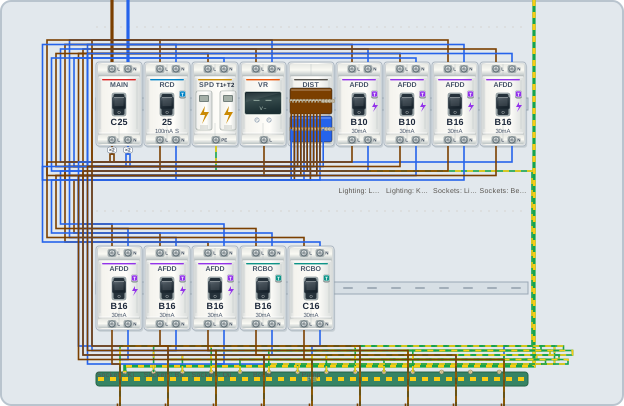
- 1×Enclosure 2×18 (36 modules), metal, surface mounting, IP44
- 1×Main breaker, C25, 2 mod.
- 1×RCD, 25 A, 100 mA type A (S), 2 mod.
- 1×Surge protection device (SPD), type 1+2, 1+1 (CT2), 2 mod.
- 1×Voltage relay, 2 mod.
- 1×Distribution block 2P 125 A, 14 terminals per pole, 2 mod.
Generated by the planner from the answers above, with a 20% reserve target. Your summer house will differ: the earth electrode, connection and sign-off belong to a licensed electrician.
Plan it, step by step
Six steps from the meter on the pole to a draft you can take to your electrician.
- 1
Find out the supply and earthing
Ask the network operator for the supply rating and earthing system. For TT you need your own earth electrode; for TN-C-S the PEN is split at the house with its own earthing.
- 2
Note the building and conditions
Timber walls call for AFDD, flame-retardant cable, a metal enclosure and surface wiring or metal conduit. An unheated house needs an IP44 enclosure.
- 3
List rooms, outdoor areas and the pump
Lights and sockets room by room, then the terrace, garden and well. Note how far the pump is from the panel.
- 4
Fit the loads into the supply
With 25 A, the water heater, pump, kettle and a heater can trip the main breaker together. Plan which appliances you will avoid running at once.
- 5
Choose the protection
A 30 mA RCD on every circuit, a selective main RCD in TT, an SPD for the overhead line and, if the line is weak, a voltage relay.
- 6
Export and hand over
Export the wiring diagram, shopping list and assembly steps. A licensed electrician installs and measures the earth electrode, connects the panel and signs it off.
The details worth getting right
Requirements
HD 60364 / local rules
- TT: RCD protection on every circuit and an earth electrode low enough for it (RA × IΔn ≤ 50 V).
- Overvoltage protection for the overhead line (HD 60364-4-44 §443).
- AFDD recommended by HD 60364-4-42 and required in some countries; in timber buildings the planner adds it.
- An enclosure rated for the room: IP44 or better in an unheated house, metal on a wooden wall.
- Connection, earth electrode testing and sign-off by a licensed electrician.
Common mistakes
Small oversights, avoidable problems
- −Using a water pipe or the fence as the earth.
- −Splitting the PEN yourself or turning a TT supply into TN without the operator.
- −Cables hidden inside timber walls without metal conduit.
- −A plastic enclosure on a wooden wall in an unheated, damp house.
- −A well pump on a curve B breaker that trips at every start.
Common questions
TT or TN-C-S at a summer house?
You do not choose freely: the network operator decides which system its line supports. Rural overhead lines are often TT, where your own earth electrode and RCDs provide fault protection. With TN-C-S the PEN is split at the house and earthed there. If nobody knows, an electrician has to find out before anything is connected to PE.
How do I earth a summer house?
With a dedicated earth electrode: driven rods or a buried ring, connected to the main earthing terminal of the panel. An electrician measures its resistance, which must be low enough for the RCDs to disconnect in time. Water pipes, fences and reinforcing bars are not an earth electrode by themselves.
Is an AFDD required in a wooden house?
HD 60364-4-42 recommends arc fault detection devices, and some countries require them in timber buildings or bedrooms. Arc faults in loose terminals and damaged cables are a classic cause of fires in wooden houses, so the planner adds combined AFDD + RCBO devices to lighting and socket circuits in a wooden house.
Do I need an SPD with an overhead line?
Yes. An overhead line picks up lightning surges that can damage appliances and insulation. The planner adds a combined type 1+2 SPD at the origin of the installation. It only works with a good earth connection, so the electrode must be measured.
Is a 25 A supply enough for a summer house?
For lighting, a fridge, a water heater, a well pump and a kettle, usually yes. The example estimates about 22 A of demand. Electric heating, a sauna or an EV charger need a bigger supply or careful load management, so check with the network operator first.
What should stay on when I leave for the winter?
Plan it as separate circuits: an alarm, a router or a frost-protection heater can stay on while the rest is switched off. Leave the RCDs and voltage relay in service for whatever stays powered, and press the RCD test buttons on every visit.