Before you start
Workshop loads are few but heavy. Collect these details first: they decide the supply, the breakers and the size of the enclosure.
Typical workshop circuits
Split by function, not by wall. Light and general sockets stay separate from the tools that draw large starting currents.
| Circuit | Breaker | Cable mm² | Protection | Note |
|---|---|---|---|---|
| Lighting · all areas | B10 | 3 × 1.5 | RCBO 30 mA | Add battery lights where machines keep running down. |
| Workbench sockets | B16 | 3 × 2.5 | RCBO 30 mA | Hand tools, chargers, a shop vacuum. |
| Garage and storeroom sockets | B16 | 3 × 2.5 | RCBO 30 mA | Keep the car bay separate from the bench. |
| Air compressor | C16 | 3 × 2.5 | Own RCBO 30 mA | C curve for the motor start. |
| Welder, 3-phase | C16 | 5 × 2.5 | Own RCBO 30 mA | Check the RCD type in the welder manual. |
| CEE socket 16 A, 5-pin | C16 | 5 × 2.5 | Own RCBO 30 mA | 30 mA is mandatory for sockets up to 32 A. |
Lighting · all areas
- Breaker
B10- Cable · mm²
- 3 × 1.5
- Protection
- RCBO 30 mA
Add battery lights where machines keep running down.
Workbench sockets
- Breaker
B16- Cable · mm²
- 3 × 2.5
- Protection
- RCBO 30 mA
Hand tools, chargers, a shop vacuum.
Garage and storeroom sockets
- Breaker
B16- Cable · mm²
- 3 × 2.5
- Protection
- RCBO 30 mA
Keep the car bay separate from the bench.
Air compressor
- Breaker
C16- Cable · mm²
- 3 × 2.5
- Protection
- Own RCBO 30 mA
C curve for the motor start.
Welder, 3-phase
- Breaker
C16- Cable · mm²
- 5 × 2.5
- Protection
- Own RCBO 30 mA
Check the RCD type in the welder manual.
CEE socket 16 A, 5-pin
- Breaker
C16- Cable · mm²
- 5 × 2.5
- Protection
- Own RCBO 30 mA
30 mA is mandatory for sockets up to 32 A.
Values from the worked example below, not a cable-sizing calculation. Check installation method, cable length, grouping and fault current. The 3 kW machine motor is not in the table: it is protected by a motor protection breaker (MPCB 4–6.3 A, set to 5.8 A), not a B or C breaker.
A plan, made tangible
A typical double-garage workshop on a 3-phase 32 A supply. Seven circuits, each heavy tool on its own line, the machine motor on a motor protection breaker.
Garage workshop, 3-phase 32 A
Work area, garage bay and storeroom with a compressor, 6 kW welder, 3 kW machine motor and a 16 A CEE socket.
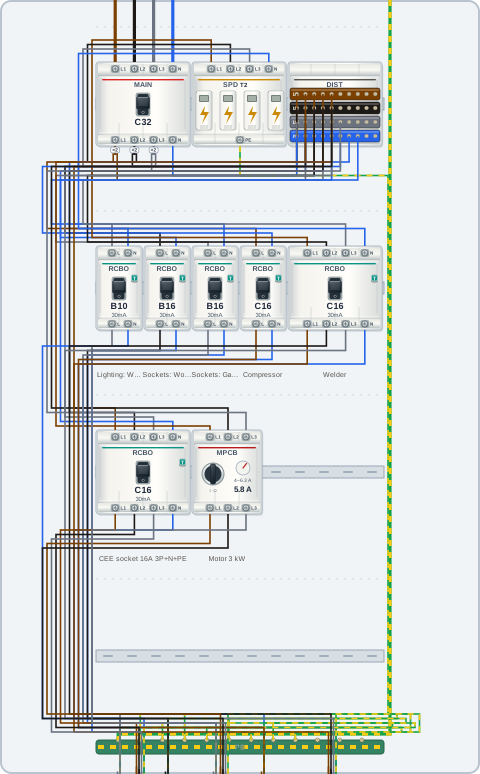
- 1×Enclosure 4×12 (48 modules), plastic, flush mounting, IP30
- 1×Main breaker, C32, 4 mod.
- 1×Surge protection device (SPD), type 2, 3+1 (CT2), 4 mod.
- 1×Distribution block 4P 125 A, 10 terminals per pole, 4 mod.
- 1×RCBO, B10, 30 mA type A, 2 mod.
- 2×RCBO, B16, 30 mA type A, 2 mod.
Generated by the planner with a 20% reserve target. The planner picks the enclosure by location (IP30 indoors) and flags IP54 for a dusty workshop: accept the fix before ordering.
Plan it, step by step
Six steps from a list of tools to a draft you can check with your electrician.
- 1
List every tool and where it is used
Write down each machine with its power and phases from the rating plate. Note which tools run at the same time: compressor and welder together is the usual peak.
- 2
Confirm the supply
Record phases, main breaker and earthing. A 3-phase machine or welder on a single-phase supply needs a different machine or a converter, not just a bigger breaker.
- 3
Give heavy tools their own circuits
Compressor, welder, machines and the CEE socket each get a dedicated line with a C-curve breaker or, for direct-on-line motors, a motor protection breaker set to the rated current.
- 4
Protect people at the sockets
Every socket, including the CEE outlet, gets 30 mA RCD protection. A fixed motor on an MPCB in a TN system usually does not, but follow the design and local rules; a TT supply needs RCDs on every circuit.
- 5
Choose a dust-proof enclosure and leave space
Pick an IP54 or better enclosure and sockets suited to the dust. Spread the 1-phase loads across L1, L2 and L3 and keep 20–30% free space for the next machine.
- 6
Hand the draft to an electrician
Export the wiring diagram, shopping list and assembly steps. An electrician checks cable sizes against route and length, connects the supply and tests the installation.
The details worth getting right
Requirements
HD 60364 / local rules
- Dusty location: enclosure and accessories at least IP5X; the planner asks for IP54.
- Sockets up to 32 A, CEE included, need additional protection by a 30 mA RCD.
- Motors need overload protection: an MPCB set to the rated current, or a breaker plus relay.
- Check starting current against the main breaker and voltage drop on long cable runs.
- Inspection and testing by a qualified person before the workshop is used.
Common mistakes
Small oversights, avoidable problems
- −Running the welder from a household socket through an extension reel.
- −A B-curve breaker on the compressor that trips at every start.
- −An IP30 indoor panel in a room full of grinding dust.
- −Protecting a motor with a plain breaker and no overload setting.
- −One lighting circuit shared with the sockets: a tripped grinder leaves you in the dark.
Common questions
Do I need three-phase power in a garage workshop?
Not for hand tools and a small compressor. You need it for 3-phase machines, larger welders and CEE 5-pin sockets, and it spreads heavy loads better. The example uses 3-phase 32 A; check with your network operator what upgrade is possible.
What breaker and cable does a welder need?
Follow the welder’s manual: it gives the supply fuse or breaker size. In the example a 6 kW 3-phase inverter welder gets C16 and 5 × 2.5 mm². Many manuals ask for a type B or F RCD because inverters can leak DC; the default here is type A, so check yours.
Does a CEE (industrial) socket need an RCD?
Yes. Under HD 60364-4-41 sockets up to 32 A need additional protection by a 30 mA RCD, whatever their shape. The planner always puts a 30 mA RCBO on a CEE socket line and reports an error if you remove it.
Which breaker suits an air compressor?
A C-curve breaker on its own circuit. The motor start draws several times its rated current for a moment, which can trip a B curve. A 2.2 kW single-phase compressor gets C16 and 2.5 mm² in the example; larger 3-phase units need their nameplate checked.
What IP rating does a workshop consumer unit need?
Where dust is produced, aim for IP54 or better for the enclosure and the sockets near the machines. The planner chooses the enclosure by location, so it flags IP30 in a workshop and offers IP54 as a one-click fix.
How do I protect a lathe or saw motor?
A direct-on-line motor gets a motor protection breaker (MPCB) with its thermal setting at the rated current from the nameplate: 5.8 A for the 3 kW motor in the example. A motor on a variable-speed drive gets a C breaker instead, as the drive manual says.
Can I wire the workshop myself?
Planning yourself is fine and saves the electrician time. Connecting the supply, and in many countries the whole installation, must be done or at least inspected and tested by a qualified electrician. Use the PDF as a working draft, not as approval.