Before you start
In a production hall the motor list drives everything: supply size, main breaker, cable and enclosure. Collect it first.
Typical production circuits
Motors get dedicated lines with motor protection; lighting and sockets stay on 30 mA RCBOs. The rows below come from the worked example with three different starting methods.
| Circuit | Breaker | Cable mm² | Protection | Note |
|---|---|---|---|---|
| Shop-floor lighting × 2 | B10 | 3 × 1.5 | RCBO 30 mA | 400 m² × 5 W/m² = 2 kW, split into two circuits. |
| Office lighting | B10 | 3 × 1.5 | RCBO 30 mA | Separate from the hall. |
| Emergency lighting | B6 | 3 × 1.5 | Own RCBO 30 mA | Self-contained fittings; layout to EN 1838. |
| Service sockets | B16 | 3 × 2.5 | RCBO 30 mA | Hand tools, chargers, cleaning machines. |
| CEE socket 32 A, 5-pin | C32 | 5 × 6 | Own RCBO 30 mA | Welder or mobile machines; breaker matches the socket. |
| Compressor 4 kW, 3-phase | C16 | 5 × 2.5 | Own RCBO | C curve for the start; follow the datasheet. |
| Saw motor 4 kW · DOL | MPCB 6–10 | 4 × 1.5 | MPCB + contactor | Setting 7.7 A = In; start/stop buttons per the project. |
| Fan motor 7.5 kW · soft start | MPCB 13–18 | 4 × 4 | MPCB | Setting 14.2 A; the soft starter sits by the machine. |
| Extractor 11 kW · VFD | C32 | 4 × 6 | C32, no 30 mA | Drive outside the panel; screened motor cable. |
Shop-floor lighting × 2
- Breaker
B10- Cable · mm²
- 3 × 1.5
- Protection
- RCBO 30 mA
400 m² × 5 W/m² = 2 kW, split into two circuits.
Office lighting
- Breaker
B10- Cable · mm²
- 3 × 1.5
- Protection
- RCBO 30 mA
Separate from the hall.
Emergency lighting
- Breaker
B6- Cable · mm²
- 3 × 1.5
- Protection
- Own RCBO 30 mA
Self-contained fittings; layout to EN 1838.
Service sockets
- Breaker
B16- Cable · mm²
- 3 × 2.5
- Protection
- RCBO 30 mA
Hand tools, chargers, cleaning machines.
CEE socket 32 A, 5-pin
- Breaker
C32- Cable · mm²
- 5 × 6
- Protection
- Own RCBO 30 mA
Welder or mobile machines; breaker matches the socket.
Compressor 4 kW, 3-phase
- Breaker
C16- Cable · mm²
- 5 × 2.5
- Protection
- Own RCBO
C curve for the start; follow the datasheet.
Saw motor 4 kW · DOL
- Breaker
MPCB 6–10- Cable · mm²
- 4 × 1.5
- Protection
- MPCB + contactor
Setting 7.7 A = In; start/stop buttons per the project.
Fan motor 7.5 kW · soft start
- Breaker
MPCB 13–18- Cable · mm²
- 4 × 4
- Protection
- MPCB
Setting 14.2 A; the soft starter sits by the machine.
Extractor 11 kW · VFD
- Breaker
C32- Cable · mm²
- 4 × 6
- Protection
- C32, no 30 mA
Drive outside the panel; screened motor cable.
Values from the worked example below (TN-C-S, cos φ 0.85, short runs), not a cable-sizing calculation. Check the drive manual for its required fuse or breaker, starting voltage drop, grouping and fault-loop impedance. RCDs on motor circuits and selectivity are decided in the project.
The worked example
The planner calculated each motor’s rated current, chose motor protection breakers and a contactor, and added a shunt trip for the fire switch and emergency lighting on its own RCBO.
Production hall 400 m², 3-phase 63 A
Shop floor, office and restroom; three motors (DOL, soft start, VFD), compressor and a 32 A CEE socket.
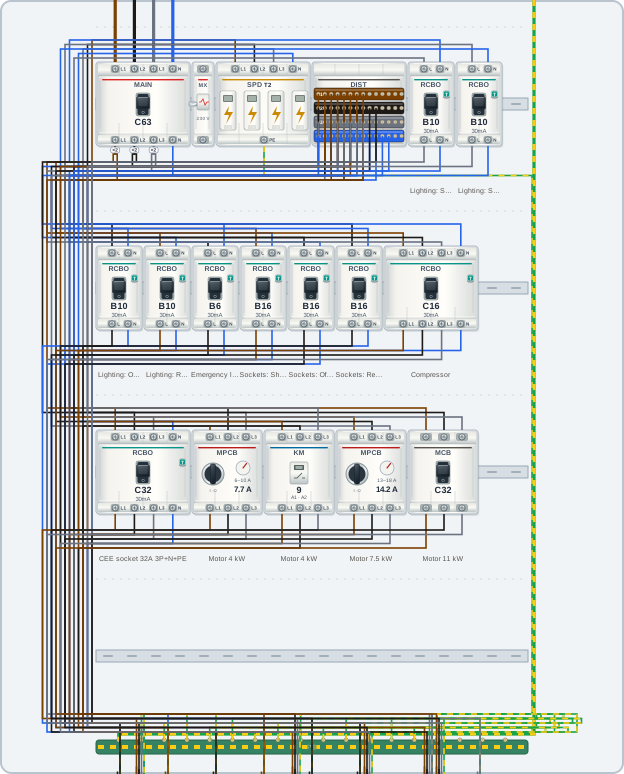
- 1×Enclosure 4×18 (72 modules), plastic, flush mounting, IP30
- 1×Main breaker, C63, 4 mod.
- 1×Shunt trip for the incoming device, mechanically coupled to the incoming device, coil 230 V AC (accessory of the same manufacturer), 1 mod.
- 1×Surge protection device (SPD), type 2, 3+1 (CT2), 4 mod.
- 1×Distribution block 4P 125 A, 14 terminals per pole, 4 mod.
- 4×RCBO, B10, 30 mA type A, 2 mod.
Generated with a 20% reserve target and a demand factor of 0.75. The planner flags the IP30 enclosure in a dusty hall and offers IP54 with one click. Final devices follow the signed project.
Plan it, step by step
Seven steps from a machine list to a draft the designer can check and sign.
- 1
Record the supply and earthing
Phases, main protection rating and earthing system. Note the prospective short-circuit current: breakers and motor protection breakers must be rated for it.
- 2
Enter the hall by floor area
For the shop floor enter m² and W/m². The planner splits the lighting into B10 circuits of about 1.5 kW. Emergency lighting and the fire switch are on by default.
- 3
Add each motor
Enter shaft power, phases, start method, cos φ and efficiency. The planner computes In = P / (√3 · 400 V · cos φ · η), picks the MPCB range around In and adds a contactor if the motor starts from the panel.
- 4
Add sockets and other machines
CEE 16 or 32 A sockets get a C breaker matching the socket and a 30 mA RCBO. Compressors, welders and machine tools get dedicated lines sized by power and phases.
- 5
Check starting and demand
The planner warns if a DOL start can trip the main breaker or drop the voltage over 10%. A demand factor of 0.75 is applied to size the main and show the phase currents.
- 6
Review protection and selectivity
Fix the warnings: IP54 enclosure, 30 mA on CEE sockets, a 300 mA fire RCD for sandwich-panel halls. Check selectivity between group breakers and the main — large groups behind a small main lose it.
- 7
Hand the draft to the designer
Export the PDF with the single-line diagram, shopping list and MPCB settings. An authorised designer completes the project, including control circuits and emergency stop.
Rules and common mistakes
Requirements
HD 60364 / EN 60204-1 / local rules
- Overload and short-circuit protection of each motor circuit, coordinated with its starter (HD 60364-4-43).
- Sockets up to 32 A, CEE included, need 30 mA additional protection (HD 60364-4-41 §411.3.3).
- RCD type B where a drive can cause smooth DC leakage; fire-protection RCD ≤ 300 mA where required.
- Machine control, emergency stop and isolation follow EN 60204-1 and the machine documentation.
- Emergency lighting to EN 1838 and HD 60364-5-56; fire switch where local rules require it.
- Initial verification, inspection and testing before handover (HD 60364-6).
Common mistakes
Small oversights, avoidable problems
- −A plain C breaker on a motor with no overload protection.
- −MPCB setting taken from the breaker range, not from the rating plate.
- −A large DOL motor behind a small C-curve main breaker that trips on every start.
- −A 30 mA type A RCD in front of a drive: nuisance trips or no protection at all.
- −CEE sockets left without 30 mA because “it is industrial”.
- −An IP30 enclosure where there is swarf and dust.
Common questions
Motor protection breaker or circuit breaker for a motor?
For DOL and soft-start motors, a motor protection breaker (MPCB) protects against both short circuit and overload, with a thermal setting adjusted to the rated current. A plain breaker has no adjustable overload. In front of a VFD, use the breaker or fuses the drive manual specifies — the drive usually provides the motor overload protection.
How do I calculate the rated current of a three-phase motor?
In = P / (√3 · U · cos φ · η), with P the shaft power. For 4 kW at 400 V, cos φ 0.85 and η 0.88 this gives 7.7 A. Always prefer the current on the rating plate. Set the MPCB thermal release to In; the cable is sized for at least 1.25 · In plus voltage drop.
Does a motor need a 30 mA RCD?
Fixed motors do not need 30 mA additional protection; fault protection comes from automatic disconnection by the breaker in TN systems. In TT, or where the project requires it, a 300 mA RCD is used — type B in front of a drive. Sockets, including CEE sockets, always need 30 mA.
When should I use a soft starter or a VFD instead of DOL?
When the starting current is too high for the supply or the main breaker, when the voltage drop on start disturbs other loads, or when the process needs speed control. The planner warns when a DOL start exceeds the magnetic trip of the main breaker.
What demand factor applies to a production hall?
The planner uses 0.75 for production, as machines rarely run at full load together. It is a starting estimate: a designer with the shift pattern and process data may use per-machine utilisation and simultaneity factors instead.
Can I build the panel from the generated PDF?
No — the PDF is a working draft for the designer and electrician. A production building needs a project by an authorised designer, including machine control, emergency stop and the fire strategy. A qualified electrician then installs, inspects and tests.